
Will MSTY ETF Dividend Yield Sustain in 2025? A Risk Analysis
Hello, this is JEJE Finance. In today’s article, we’ll examine whether the MSTY ETF dividend yield can maintain its momentum into 2025. Personally, I believe the sustainability of such extreme yields presents significant challenges that investors should carefully consider before allocating capital to this instrument.
The Strategy Behind MSTY: Covered Calls on MSTR
The Yield Max MSTR Option Income Strategy ETF (MSTY) has garnered substantial attention from income-seeking investors due to its extraordinary 123% dividend yield over the past 12 months. This eye-catching MSTY ETF dividend yield has positioned it as one of the highest-yielding investment vehicles in the market. However, this remarkable return raises critical questions about its sustainability and the underlying risk factors that could impact its performance in the coming year.
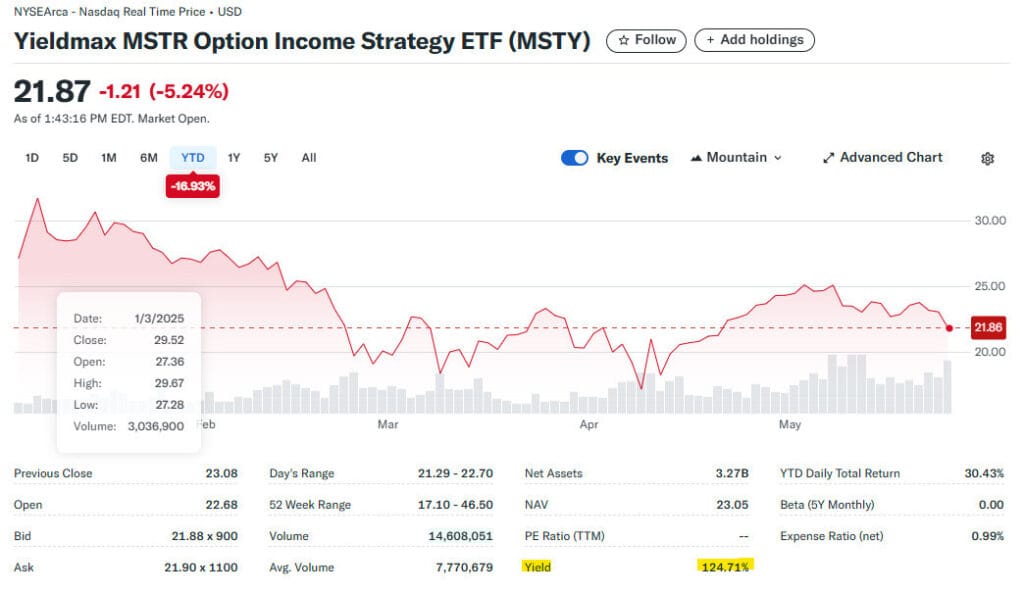
MSTY ETF was designed to generate income through a covered call options strategy on MicroStrategy (MSTR) stock. While this approach has successfully delivered substantial monthly distributions thus far, the long-term viability of maintaining such elevated yields deserves thorough scrutiny. The question remains: can investors realistically expect the MSTY ETF dividend yield to continue at these levels, or are we witnessing a temporary phenomenon that could lead to disappointment?
Understanding MSTY’s High-Yield Strategy
To properly assess the sustainability of the MSTY ETF dividend yield, investors must first understand its underlying mechanics. MSTY employs a covered call strategy using MicroStrategy (MSTR) shares as the foundation. This approach involves holding MSTR stock while simultaneously selling call options against those positions. The premium collected from selling these options generates the income stream that funds the impressive monthly dividends.
The covered call strategy is particularly effective in certain market conditions. When the underlying asset experiences moderate price movements or trades sideways, option sellers can consistently collect premiums without having their positions called away. This explains how MSTY has managed to sustain its remarkable MSTY ETF dividend yield in recent months.

MicroStrategy, the underlying asset, presents its own set of considerations. As a business intelligence company that has strategically transformed into a Bitcoin proxy by converting much of its treasury into the cryptocurrency, MSTR’s stock performance is heavily correlated with Bitcoin price movements. This relationship introduces an additional layer of complexity when evaluating the MSTY ETF dividend yield sustainability.
The monthly dividend distribution structure has been a key selling point for MSTY. Unlike quarterly dividend payers, the monthly payment schedule provides investors with more frequent income, enhancing the appeal of the MSTY ETF dividend yield. However, this frequency also means the fund must continuously execute its options strategy successfully to maintain these distributions.
Key Risk Factors in 2025 for MSTY ETF Dividend Yield
Several critical risk factors could impact the MSTY ETF dividend yield as we move into 2025. Perhaps most significant is the effect of market volatility on option premiums. Option pricing is heavily influenced by implied volatility – higher volatility typically results in higher premiums, benefiting option sellers. However, volatility is cyclical, and periods of lower volatility could substantially reduce the income generated through the covered call strategy, potentially forcing a reduction in the MSTY ETF dividend yield.
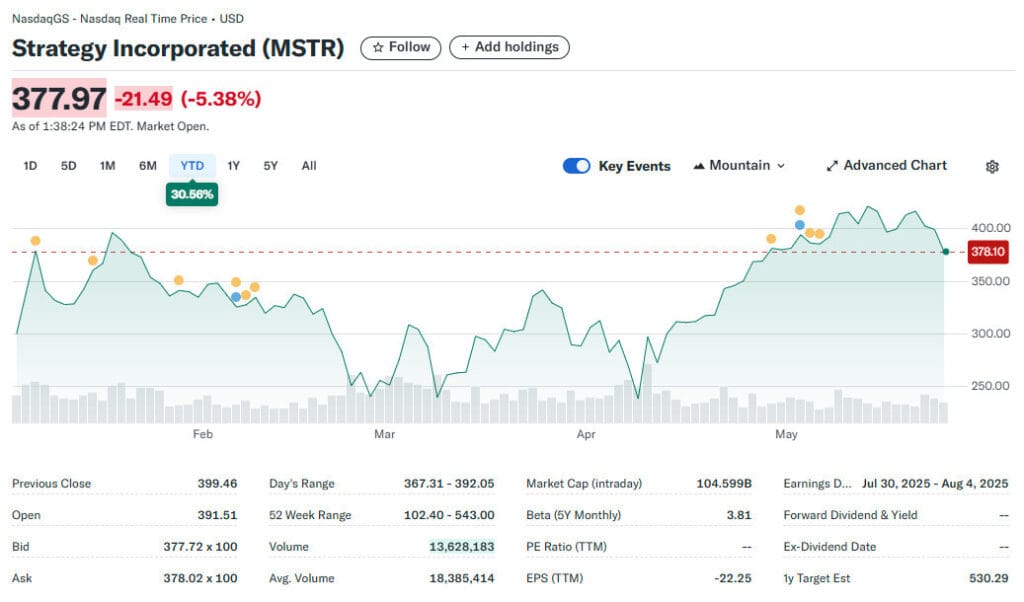
MicroStrategy stock price fluctuations represent another substantial risk factor. The company’s Bitcoin-centric strategy means its stock price is heavily influenced by cryptocurrency market movements. Should Bitcoin experience significant downward pressure in 2025, MSTR shares could decline substantially. In such a scenario, the fund would face a dual challenge: declining asset value and potentially reduced option premiums, both of which would negatively impact the MSTY ETF dividend yield.
The sustainability challenges inherent in the covered call strategy itself cannot be overlooked. This approach sacrifices upside potential in exchange for immediate income. During strong bull markets, covered call strategies typically underperform the underlying asset as call options are exercised, forcing the seller to cap gains. Over time, this can erode the capital base upon which the strategy depends, potentially threatening the long-term viability of the MSTY ETF dividend yield.
Furthermore, the fund’s concentrated exposure to a single stock (MSTR) introduces significant idiosyncratic risk. Any company-specific issues affecting MicroStrategy could have an outsized impact on MSTY’s performance, regardless of broader market conditions or the effectiveness of its options strategy in generating income.
Investment Considerations for 2025
When evaluating the MSTY ETF dividend yield for investment purposes in 2025, a comprehensive risk-reward analysis is essential. While the current 123% yield appears extremely attractive, investors must consider the total return potential, which includes both dividend income and potential capital appreciation or depreciation. Historical data suggests that extremely high yields often signal elevated risk levels rather than sustainable income opportunities.
For portfolio allocation purposes, financial advisors typically recommend limiting exposure to high-risk, high-yield investments like MSTY. Even for investors with high risk tolerance, allocating no more than a small percentage of a diversified portfolio to such instruments may be prudent. The MSTY ETF dividend yield, while appealing, should be viewed as a speculative income opportunity rather than a core holding.

Investors seeking high-yield alternatives might consider a more diversified approach. Other options income ETFs spread risk across multiple underlying assets rather than concentrating on a single stock. Additionally, a self-constructed portfolio of dividend-paying stocks, preferred securities, and fixed-income instruments might provide a more sustainable income stream with better risk-adjusted returns than relying heavily on the MSTY ETF dividend yield.
Market conditions will significantly influence MSTY’s performance in 2025. Particular attention should be paid to Bitcoin price trends, overall market volatility, and interest rate environments – all factors that could substantially impact both MSTR stock performance and options pricing dynamics.
The tax implications of MSTY’s distributions also warrant consideration. High-yield instruments often distribute return of capital or short-term capital gains, which may be taxed differently than qualified dividends. This could meaningfully affect the after-tax returns from the MSTY ETF dividend yield, especially for investors holding the fund in taxable accounts.
YieldMax, the fund provider, also offers similar covered call ETFs on other high-volatility stocks. Comparing MSTY’s structure, performance, and risk metrics against these sister funds might provide additional context for evaluating its future prospects and the sustainability of its dividend yield.
Conclusion
The MSTY ETF dividend yield of 123% certainly captures attention in a market where income is highly valued. However, sustainability concerns loom large as we look toward 2025. The fund’s reliance on a single high-volatility underlying asset, combined with the inherent limitations of covered call strategies during strong directional markets, suggests caution is warranted.
For investors considering MSTY, understanding the mechanics behind its impressive yield is crucial. This isn’t a traditional dividend derived from business operations but rather income generated through an options strategy with specific risk characteristics and limitations. The MSTY ETF dividend yield, while currently attractive, carries no guarantees for future performance.
Ultimately, MSTY represents a high-risk, potentially high-reward proposition that may be appropriate for a portion of certain investors’ portfolios. However, those seeking reliable income streams for retirement or other essential purposes might be better served by more diversified, lower-yielding alternatives with greater sustainability.
As we move into 2025, market conditions, Bitcoin performance, and overall volatility trends will determine whether the MSTY ETF dividend yield can maintain its impressive track record or revert to more modest levels. Investors should approach with appropriate expectations and a clear understanding of the underlying risks involved.
Reference URL: https://seekingalpha.com/article/4785524-can-msty-etf-120-percent-plus-yield-hold-up
I also recommend that you take a look at the following content.
Palantir Technologies: A Leader in Data Analytics Innovation